
eSIM vs. Physical SIM: Is now the right time to switch to an eSIM? Learn the pros and cons
E-SIMs are gradually becoming the new standard for smartphones. However, physical SIMs are still widely used. Both have their own advantages and limitations, which are important to understand.
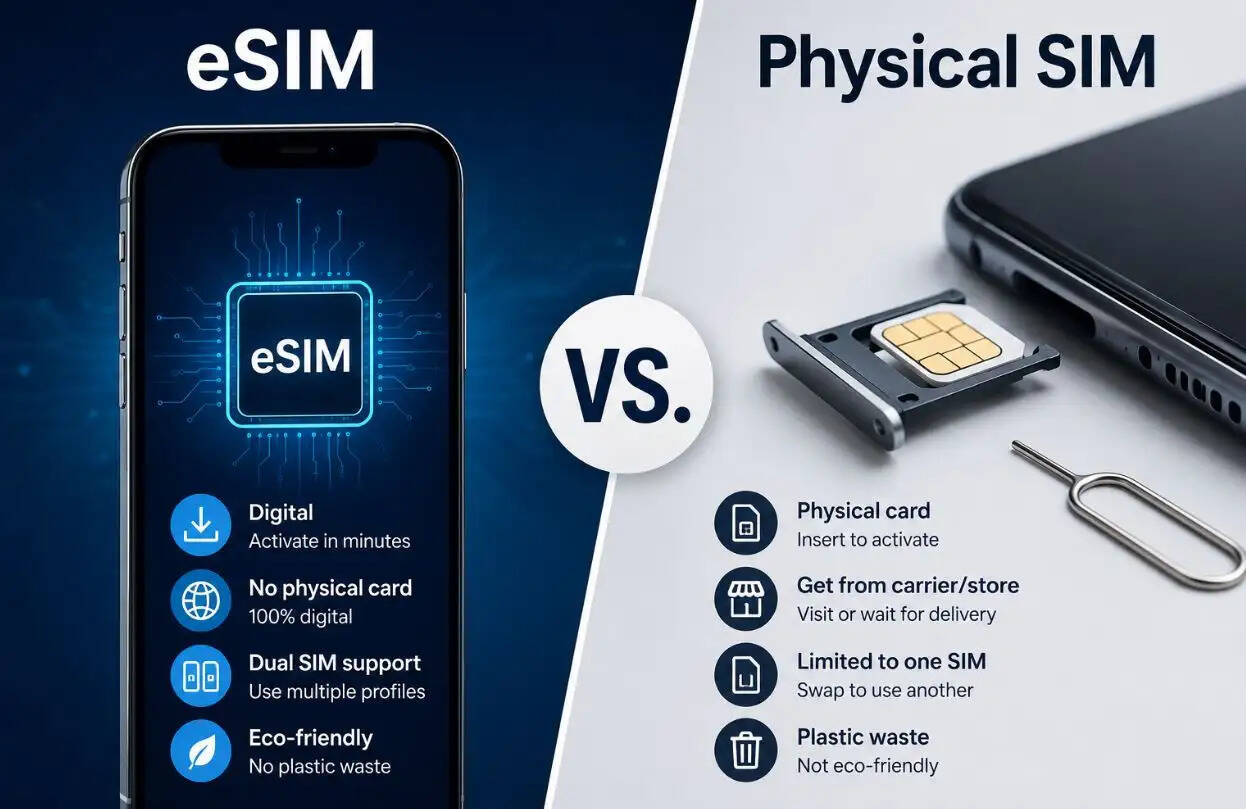
RJ Kesari News Desk: eSIM vs. Physical SIM: The smartphone world is rapidly changing, and the use of eSIMs is also increasing. Many new smartphones are coming with eSIM support, while in some countries, eSIM-only models are also available.
From the iPhone to premium phones from Samsung and Google Pixel, eSIM options are now available.
Many users are wondering whether ditching a physical SIM and adopting an eSIM is the right decision. Let's explore the differences, advantages, and disadvantages between the two, so you can choose the right option for your needs.
What is the difference between e-SIM and physical SIM?
A physical SIM is a small plastic card that is inserted into a smartphone to access the mobile network. An e-SIM, on the other hand, is a digital SIM that is already present within the phone and does not require a separate insertion.
An e-SIM is activated by downloading the mobile operator's profile. This eliminates the hassle of removing or replacing the SIM. This is why many new smartphone companies are increasingly emphasizing e-SIM support.
Advantages and disadvantages of e-SIM
The biggest advantage of e-SIM is that there's no fear of losing or damaging the SIM card. In many cases, when switching to a new connection or network, service can be activated simply by downloading a profile.
Furthermore, reducing the need for a SIM tray inside the phone gives companies greater design flexibility.
However, not every smartphone and every telecom network currently supports e-SIM. For some users, if a phone replacement or problem occurs, reactivating an e-SIM may be slightly more time-consuming than using a physical SIM.
Benefits of eSIM
- No physical SIM is required.
- The hassle of removing or inserting the SIM is eliminated.
- The new network profile can be activated digitally.
- Multiple e-SIM (7-8) profiles can be saved in a single phone.
- There is no fear of losing, breaking or damaging the SIM.
- The design of the phone can be made more compact and better.
- Switching to a local network can be handy when traveling abroad.
- The absence of a SIM tray could help improve dust and water protection.
- If the phone is stolen, it is not easy to remove the SIM and switch it off.
- Being a new technology, its use in future smartphones is continuously increasing.
Why a physical SIM is still the better option
Physical SIMs remain the most widely used option today. They can be easily removed from any supported phone and inserted into another.
If the phone breaks down, the SIM can be immediately removed and used in another device. This is why many users still find physical SIMs more convenient. However, there is a risk of losing, breaking, or damaging the SIM card, which e-SIMs do not.
Should you switch to e-SIM?
If your smartphone and your mobile network support e-SIMs and you're looking to try the new technology, an e-SIM may be a good option.
However, if you frequently change phones or use a network that doesn't offer e-SIMs, a physical SIM may be more convenient for you.
Both technologies have their own advantages and limitations, so it's best to make your decision based on your needs, phone, and network support.