
BhuDEV App Explained: How India's Earthquake Alert System Warns You Before Strong Tremors Hit
BhuDEV App | Earthquake Early Warning System: While scientists still cannot predict exactly when an earthquake will occur, modern technology can now provide valuable seconds of advance warning after a quake begins. India has developed an Earthquake Early Warning System (EEWS) for the Himalayan region that detects the first seismic waves and alerts people before stronger shaking reaches them.
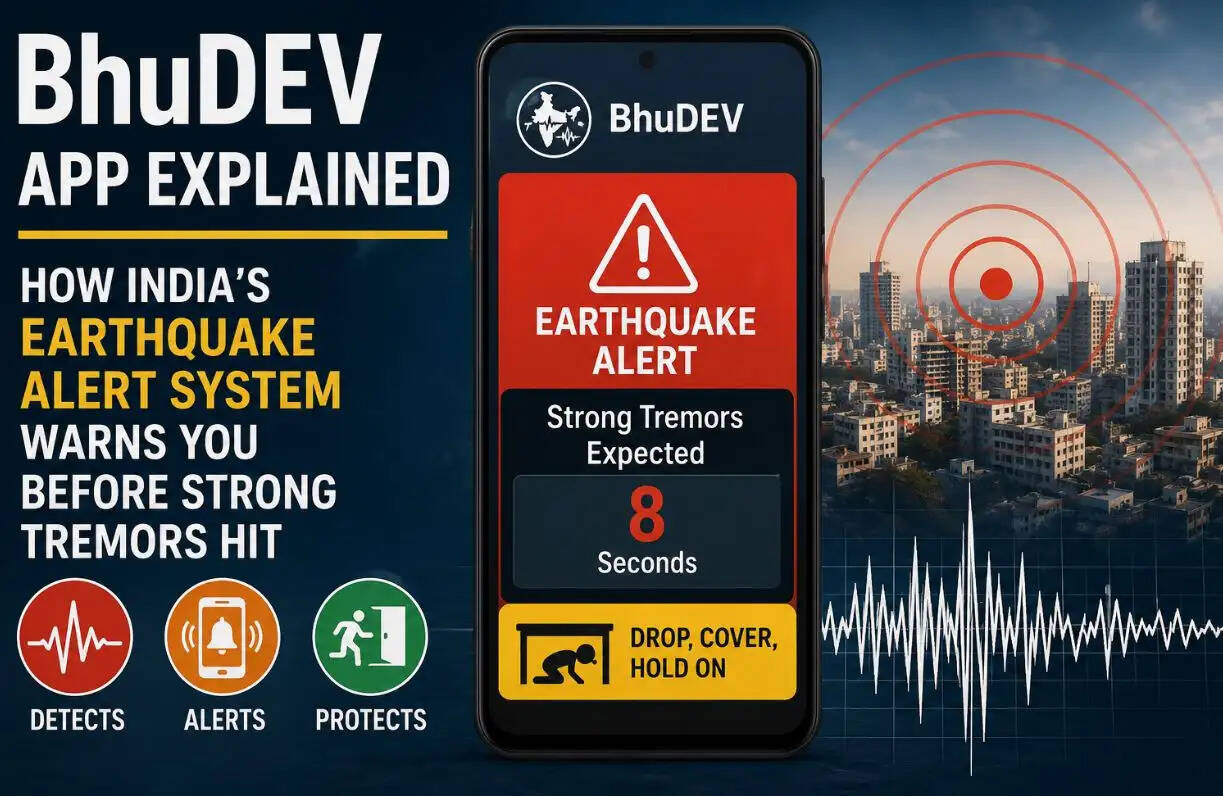
The warning may last only a few seconds, but those precious moments can help people move to safer locations, stop dangerous activities, and reduce the risk of injury during an earthquake.
Can India Predict Earthquakes?
The simple answer is no.
The Government of India has clarified that there is currently no scientifically proven technology capable of accurately predicting earthquakes before they happen.
Instead, India is focusing on Earthquake Early Warning Systems, which do not forecast earthquakes in advance but detect them immediately after they begin. These systems identify the first seismic waves and issue alerts before the more destructive waves arrive.
Even a warning of 5 to 30 seconds, depending on the distance from the epicenter, can make a significant difference during an emergency.
What Is the BhuDEV App?
The BhuDEV App is a mobile application developed by IIT Roorkee in collaboration with the Uttarakhand Government.
The app is connected to a network of seismic sensors installed across earthquake-prone areas of the Himalayan region. Once an earthquake is detected, the system quickly analyzes the event and sends instant alerts to users who may be affected.
At the same time, the National Centre for Seismology (NCS) is testing advanced algorithms that can rapidly detect P-waves, estimate earthquake intensity, and assess the possibility of aftershocks.
How Does India's Earthquake Early Warning System Work?
When an earthquake occurs, it generates different types of seismic waves.
The first to arrive are known as Primary Waves (P-Waves). These travel at the highest speed and usually cause minimal damage.
They are followed by Secondary Waves (S-Waves) and Surface Waves, which are much more destructive and responsible for most earthquake damage.
The warning system works in four simple steps:
- Seismic sensors detect the fast-moving P-waves immediately after an earthquake begins.
- The system quickly calculates the earthquake's location, depth, and expected intensity.
- Automatic alerts are sent to mobile apps and connected emergency systems.
- People receive a few seconds of warning before the stronger shaking reaches their location.
Although the warning time is short, it can be enough to seek shelter, stop machinery, pause train operations, or activate emergency response systems.
Where Is the Earthquake Warning System Installed?
At present, India's Earthquake Early Warning System is primarily operational in the Garhwal and Kumaon regions of Uttarakhand.
A network of highly sensitive seismic sensors has been installed near active fault lines to detect earthquakes as quickly as possible.
As the system expands, more earthquake-prone regions may benefit from similar early warning technology.
How Much Warning Time Can People Get?
The amount of warning depends mainly on how far a person is from the earthquake's epicenter.
- Areas very close to the epicenter may receive little or no warning because destructive waves arrive almost immediately.
- Cities located farther away can receive anywhere from a few seconds to several tens of seconds of advance notice before strong shaking begins.
Even a brief warning allows schools, hospitals, industries, and emergency services to take immediate protective action.
How Does India Compare with Other Countries?
Several countries have already developed highly advanced earthquake early warning systems.
Among the global leaders are:
- Japan
- Taiwan
- United States
These countries operate extensive seismic monitoring networks capable of issuing automatic alerts within seconds of an earthquake's detection.
India's system is still expanding but represents a major step toward improving disaster preparedness in earthquake-prone regions.
Why Are Earthquake Early Warnings Important?
Although earthquakes cannot be prevented or accurately predicted, early warning technology can significantly reduce casualties and damage.
Advance alerts can help:
- People move to safer locations
- Schools and offices begin emergency procedures
- Hospitals protect critical equipment
- Factories stop hazardous operations
- Railways slow or halt trains
- Emergency responders prepare immediately
Every second gained before a major tremor can help save lives.