
The Biggest Myth About EPF Interest: Here is How Your PF Amount Grows Behind the Scenes
The Employees' Provident Fund Organization (EPFO) has officially locked in the 8.25% interest rate for the financial year 2025-26. Millions of salaried employees across India are eagerly waiting, with expectations that the accumulated interest will be digitally credited to their official EPF passbooks by July 15, 2026.
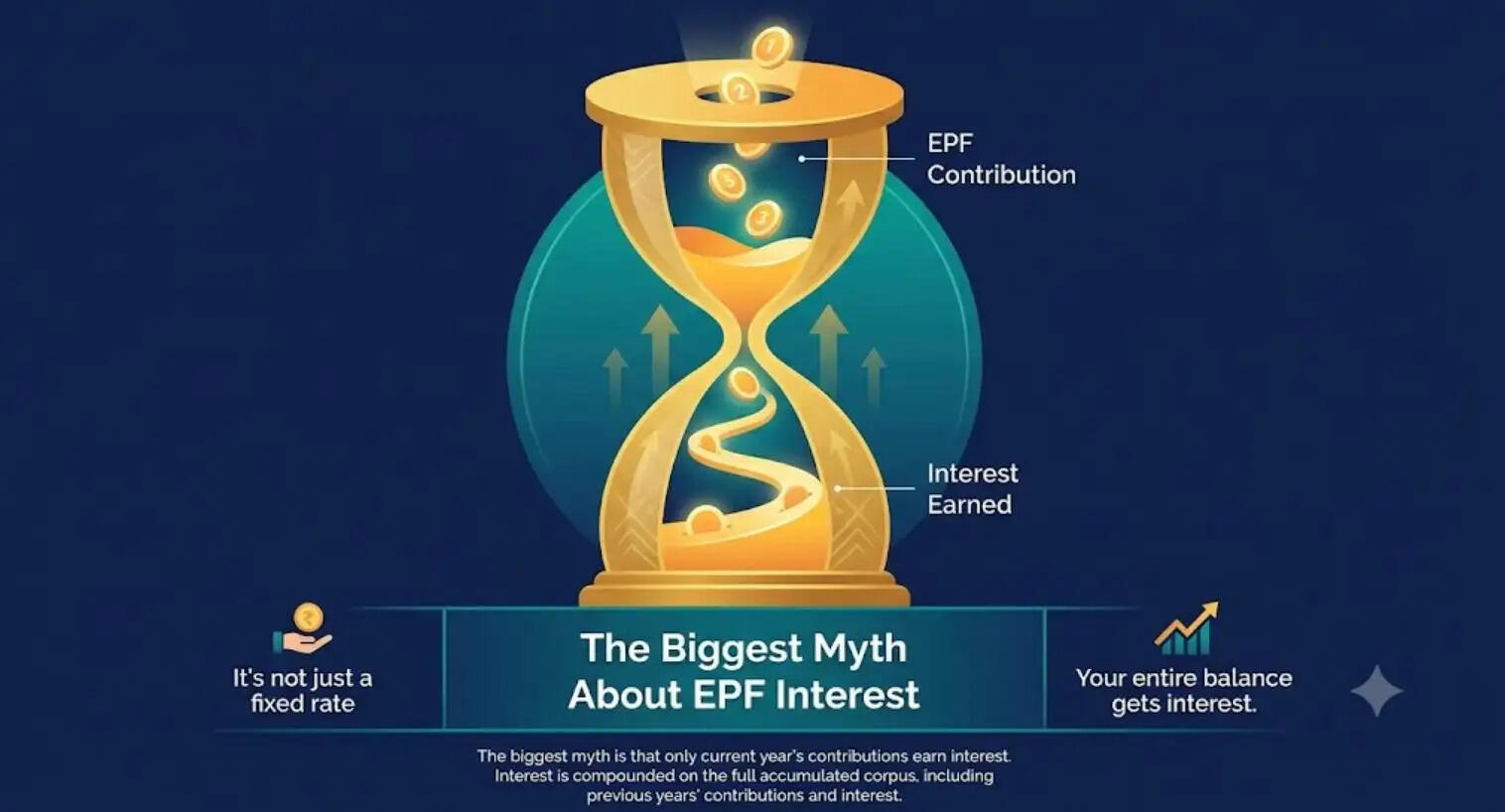
RJ Kesari News Desk: However, a common point of confusion among working professionals persists: If the interest is technically calculated every single month, why does it only show up in the account once a year?
Let’s break down the mechanics of your retirement fund in simple terms.
🛑 Myth vs. Reality: The Annual Credit Rule
A frequent misconception is that an annual interest rate of 8.25% means a monthly slice of roughly 0.69% is directly deposited into your fund every 30 days. This is mathematically incorrect.
The Gold Standard Rule: The EPFO evaluates and logs your interest monthly based on your running balance, but it never deposits it monthly. Instead, the interest accrued over all 12 months is aggregated and credited to your account as a single, lump-sum transaction at the close of the financial year.
This explains why your mid-year passbook statements never show an active interest column, even though your savings are steadily accumulating returns behind the scenes.
🧮 Step-by-Step: How the Monthly Calculation Works
Your monthly PF balance is a moving target because of ongoing payroll deductions. The interest calculation adapts to this shifting principal amount every month.
-
The Opening Balance: Suppose you have a base balance of ₹5 Lakh on April 1st.
-
The Monthly Contribution: Every month, your corporate salary deduction plus the matching employer contribution adds a combined ₹10,000 to the account.
-
The Calculation Cycle: For April, interest is calculated strictly on the opening ₹5 Lakh. In May, the new contribution is factored in, raising the principal base. The next month’s interest is then calculated on this higher, updated figure.
This cycle repeats indefinitely. Because your principal base expands every 30 days with fresh deposits, the actual interest amount calculated grows progressively larger toward the end of the year.
📈 The Snowball Effect of PF Compounding
Over a 12-month period, if you and your employer deposit a combined sum of ₹1.2 Lakh, you aren't just earning interest on your starting corporate balance. You are unlocking the financial power of compounding.
Industry experts note that interest on every single monthly deposit kicks off the very month the cash hits the EPFO ecosystem. While the visual confirmation only drops once a year, your money never sits idle.
🛡️ Why EPF Remains India’s Premier Retirement Tool
Even with modern investment alternatives, financial planners universally agree that the Employees' Provident Fund is one of the safest and most lucrative long-term debt instruments available:
| Feature | Financial Benefit |
| Guaranteed Return | A steady 8.25% annual return, easily outperforming standard bank fixed deposits. |
| Tax Advantages | Enjoys EEE (Exempt-Exempt-Exempt) tax status, meaning the investment, interest, and maturity are tax-free. |
| Employer Matching | Instant 100% return on your personal investment via the mandatory corporate match. |
| Long-Term Growth | Continuous, undisturbed accumulation over 25 to 30 years easily builds a multi-crore retirement corpus. |
📋 Critical Takeaways for Salaried Employees
To ensure your retirement strategy remains completely secure, keep these two operational practices in mind:
-
Audit Your Passbook: Log into the official EPFO portal periodically to verify that your company is making consistent, monthly deposits.
-
Beware of Corporate Delays: If an employer delays transferring your deducted PF amounts into the government system, it directly hurts you, as your monthly interest calculation window for that specific contribution gets pushed back.