
Haryana to Introduce 925 Electric Buses in 2026; Major Push for Clean Public Transport
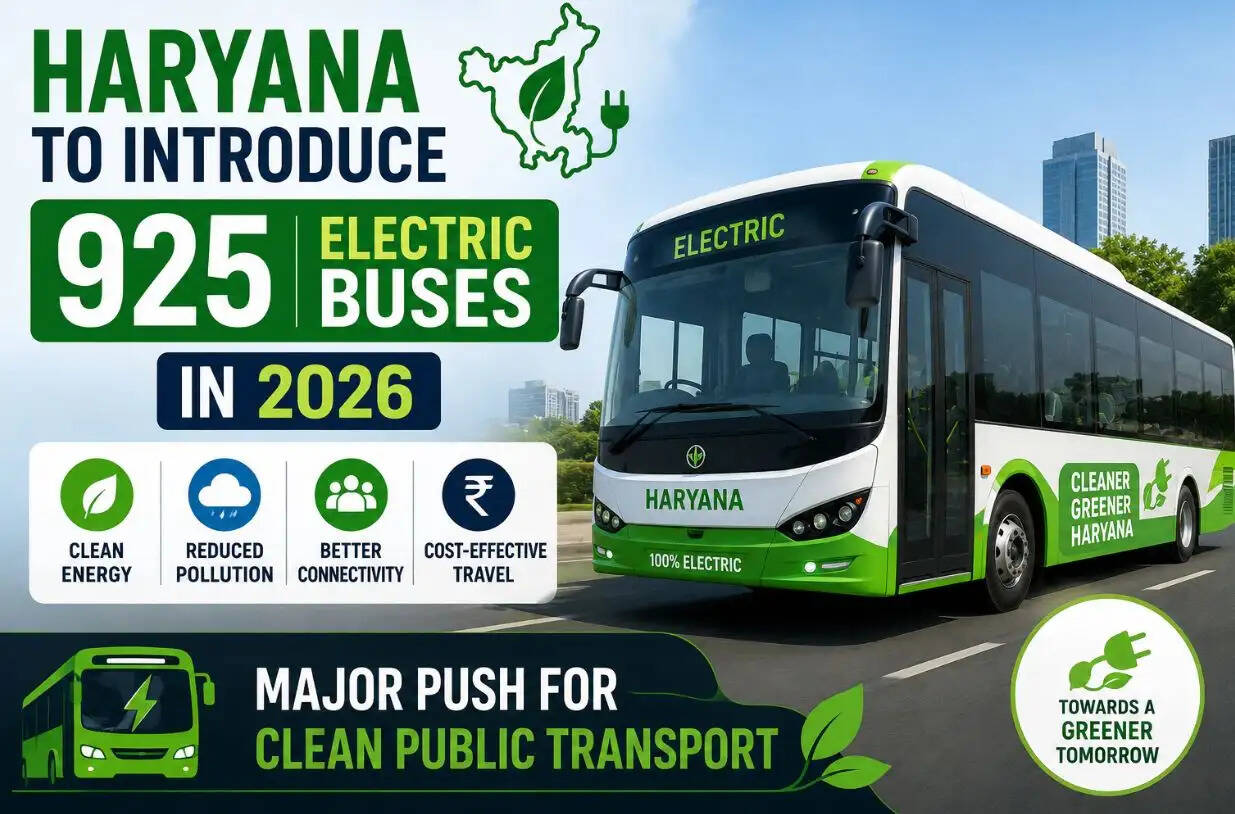
Chandigarh: In a major step towards clean and sustainable public transportation, the Haryana Government has unveiled an ambitious plan to introduce 925 electric buses across several NCR cities, including Gurugram, Faridabad, Sonipat, Panipat, Karnal, and Rohtak during 2026.
RJ Kesari News Desk: The initiative is part of the state's broader strategy to reduce vehicular emissions, improve air quality, and accelerate the adoption of environmentally friendly transportation before the upcoming winter pollution season.
925 Electric Buses to Transform Public Transport
According to officials, 70 electric buses are already operating across Haryana, while purchase orders have been issued for an additional 385 buses. The remaining fleet will be procured in phases after approval from the High-Powered Purchase Committee.
The expansion of the electric bus network is expected to significantly reduce pollution caused by conventional diesel-powered buses while providing commuters with a cleaner, quieter, and more efficient mode of transport.
The six cities covered under the first phase include:
- Gurugram
- Faridabad
- Sonipat
- Panipat
- Karnal
- Rohtak
23 New Air Quality Monitoring Stations to Be Installed
To strengthen pollution monitoring, the state government is also expanding its Continuous Ambient Air Quality Monitoring System (CAAQMS) network.
Currently, 22 monitoring stations are operational across Haryana. Another 23 new CAAQMS stations are being installed, increasing the total number to 45.
Officials aim to make the entire network fully operational before September 30, ensuring real-time monitoring of air quality during the winter months when pollution levels generally peak.
'No PUCC, No Fuel' Policy to Begin from October 1
The Haryana Government has also confirmed that the 'No PUCC, No Fuel' policy will come into effect from October 1, 2026 across NCR districts.
Under this initiative:
- Vehicles without a valid Pollution Under Control Certificate (PUCC) will not receive fuel.
- Fuel stations will electronically verify vehicle pollution certificates before dispensing fuel.
To support the system, Automatic Number Plate Recognition (ANPR) technology is being installed at 2,780 fuel stations.
The first phase will cover 775 petrol pumps in Gurugram, Faridabad, Jhajjar, and Sonipat, while the remaining stations will be equipped before the deadline.
Strict Action Against Old Polluting Vehicles
The state has intensified its enforcement drive against End-of-Life (EOL) vehicles.
So far in 2026:
- 2,883 old vehicles have been seized.
- 2,010 vehicles have been scrapped.
- 6,054 No Objection Certificates (NOCs) have been issued to facilitate voluntary vehicle replacement.
These measures are aimed at reducing pollution from aging vehicles across Haryana.
'Naya Safar Yojana' to Encourage Cleaner Vehicles
The government is also promoting the Naya Safar Yojana, which offers 100% exemption from motor vehicle tax for eligible clean-energy commercial vehicles.
Authorities are conducting awareness campaigns and enabling voucher redemption at fuel outlets to encourage transport operators to replace older vehicles with cleaner alternatives.
Nearly 1,500 Kilometres of Urban Roads Under Redevelopment
As part of its dust-control strategy, Haryana has already completed redevelopment work on nearly 490 kilometres of urban roads.
Work orders have now been issued for another 1,000 kilometres of roads across the NCR region.
The government is also preparing to sign an agreement with CSIR-Central Road Research Institute (CRRI) to adopt scientific road engineering and advanced dust-control techniques.
Industrial Pollution Monitoring Strengthened
The state's pollution control authorities are also tightening industrial emission monitoring.
Out of 1,340 industries required to install Online Continuous Emission Monitoring Systems (OCEMS), 1,329 industries have already been connected to the Central Pollution Control Board (CPCB) servers.
Industries requiring upgraded pollution control equipment are also being directed to install advanced emission control systems at the earliest.
Solid Waste and Construction Waste Management Expanded
Haryana has strengthened waste management across all NCR cities.
Key initiatives include:
- Geo-tagging of waste collection sites
- GPS tracking of construction and demolition (C&D) waste transport
- 23 operational secondary waste collection centres
- Development of additional waste processing facilities
- 100% municipal solid waste collection coverage across all seven NCR cities
These initiatives are expected to improve urban sanitation while reducing pollution caused by unmanaged waste.
Government's Focus on Cleaner Cities
Senior officials reviewed the implementation of these projects during a high-level meeting held under the Commission for Air Quality Management (CAQM).
The government has directed all concerned departments to complete the ongoing projects within the prescribed timeline so that pollution-control measures are fully operational before the onset of winter.
With the rollout of electric buses, expansion of air-quality monitoring, stricter pollution norms, and improved waste management, Haryana is aiming to significantly improve environmental conditions across the NCR region while promoting sustainable urban development.