
Government's ₹20,000 Crore Highway Monetisation Plan: Roads to Generate Revenue, Private Investment to Play Bigger Role
The Central Government is preparing a massive highway monetisation strategy that could generate an additional ₹15,000-20,000 crore in revenue during FY27. The move is part of a broader plan to attract more private investment in road infrastructure while reducing pressure on government finances.
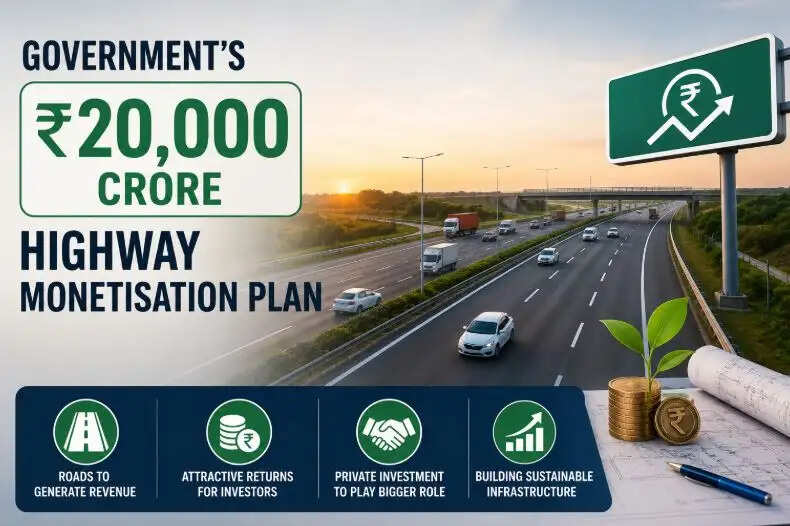
RJ Kesari News Desk: Under the proposed framework, the Ministry of Road Transport and Highways (MoRTH) intends to include investments made through the Build-Operate-Transfer (BOT) model as part of its monetisation earnings. If implemented successfully, total highway monetisation receipts could cross ₹50,000 crore in FY27, significantly higher than the ministry's current target of ₹35,000 crore.
Government Looking to Unlock Value from Highway Projects
The government wants to monetize both existing and upcoming national highway projects to ensure continuous infrastructure development without excessive dependence on budgetary allocations.
Under the BOT model, private companies finance and construct highways using their own capital. In return, they are allowed to collect toll revenue for a specified period before transferring the asset back to the government. This approach helps reduce the burden on public finances while encouraging long-term private sector participation.
Officials believe the model can provide a fresh source of capital for expanding India's rapidly growing road network.
NMP 2.0 Targets ₹16.72 Lakh Crore Monetisation Opportunity
The government's updated National Monetisation Pipeline (NMP) 2.0 estimates a total monetisation potential of around ₹16.72 lakh crore over the next five years until FY30.
Out of this amount, nearly ₹5.8 lakh crore is expected to come through private sector investments in infrastructure projects undertaken by central ministries and public sector enterprises.
Unlike the first phase of the NMP, which primarily focused on leasing existing public assets, the new framework also recognizes investments in greenfield infrastructure projects, including highways developed through the BOT route.
Highway Monetisation Has Already Delivered Strong Results
The first phase of the National Monetisation Pipeline, launched in 2021, focused on monetizing operational public infrastructure assets by leasing them to private players.
The initiative achieved nearly 90% of its target, generating approximately ₹5.3 lakh crore that was subsequently used to fund new infrastructure projects across the country.
In FY26 alone, the Road Transport Ministry earned around ₹29,000 crore through various highway monetisation programs.
Major Policy Shift in Road Monetisation Strategy
Until now, highway monetisation largely relied on two models:
- Toll-Operate-Transfer (TOT)
- Infrastructure Investment Trusts (InvITs)
Both methods involved monetizing already operational road assets by transferring revenue rights to investors.
The latest policy marks a significant shift as the government will now also count private capital invested in new BOT highway projects as part of monetisation proceeds.
Officials argue that since BOT projects reduce government spending requirements and bring fresh private investment into public infrastructure, they should qualify under the monetisation framework.
10,000 Kilometres of Highways Planned in FY27
According to government plans, approximately 10,000 kilometres of national highway projects are expected to be awarded during FY27.
Nearly 25% of these projects could be offered under the BOT (Toll) model, reflecting the government's renewed confidence in private sector participation.
The overall project value is estimated at around ₹2 lakh crore, although only ₹15,000-20,000 crore of private investment is expected to be deployed during FY27 and counted toward monetisation revenues.
Since investments in BOT projects are made gradually throughout the construction period, only the amount invested during a particular financial year will be considered for monetisation calculations.
Why Is the Government Reviving the BOT Model?
The renewed focus on the Build-Operate-Transfer model is driven by the government's objective of increasing private investment in infrastructure while lowering dependence on taxpayer-funded spending.
Officials believe investor confidence in road projects has improved significantly due to better traffic forecasting, stronger project structuring, and improved risk-sharing mechanisms.
As a result, BOT projects are expected to account for a larger share of future highway construction contracts.
India's Expanding Highway Network
India currently has a national highway network exceeding 1.46 lakh kilometres, making it one of the largest road networks in the world.
Over the past decade, highway construction was primarily driven by:
- Engineering, Procurement and Construction (EPC) Model
- Hybrid Annuity Model (HAM)
However, policymakers now see considerable potential in expanding the BOT route because it transfers traffic and revenue risks to private developers while reducing direct government expenditure.
What Infrastructure Experts Are Saying
According to Kuljeet Singh, Partner and National Infrastructure Leader at EY India, BOT projects remain attractive from the government's perspective because they eliminate major fiscal risks.
He noted that such projects require no direct capital expenditure or subsidy support from the government.
However, private investors often view BOT projects as relatively riskier due to uncertainty around traffic volumes and toll revenue generation. These projects also require significantly higher equity investments compared to EPC contracts.
Because of these factors, investor interest in BOT projects has historically been lower than in HAM and TOT models.
Recent Reforms Aim to Improve Investor Confidence
To make BOT projects more attractive, the government has introduced several changes in concession agreements.
The revised framework aims to improve risk allocation, enhance project bankability, and provide greater clarity to lenders and investors.
According to Kushal Kumar Singh, Partner at Deloitte India, including BOT investments within the monetisation framework aligns with the objectives of NMP 2.0 and represents a significant policy evolution.
The Rise, Fall and Return of BOT Projects
The BOT model once dominated India's highway development sector.
Between 2007 and 2014, almost all major highway projects were awarded under BOT arrangements. During 2011-12, nearly 96% of national highway contracts followed this model.
However, aggressive bidding, funding constraints, and lower-than-expected traffic volumes eventually reduced investor enthusiasm.
No BOT projects were awarded in FY19 and FY20. Although the National Highways Authority of India (NHAI) attempted to revive the model in 2020, meaningful project awards resumed only in 2021 after several policy improvements.
More Monetisation Opportunities Ahead
Apart from BOT projects, the government is expected to continue raising funds through TOT bundles and InvIT structures in FY27.
Officials believe these monetisation programs could match or even exceed FY26 levels, helping attract both domestic and international investors into India's infrastructure sector.
With a stronger monetisation framework, increased private sector participation, and a growing highway network, the government aims to accelerate road construction while ensuring sustainable financing for future infrastructure projects.