
Explained: Crude Oil Prices Drop 8% in a Week – Will Petrol and Diesel Become Cheaper in India?
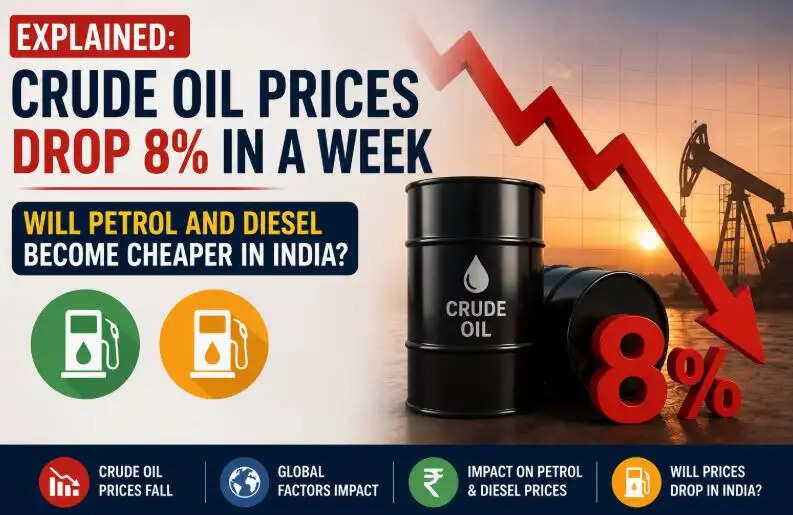
A sharp decline in global crude oil priceshas sparked hopes of relief for consumers across the world, including India. Over the past week, international crude oil benchmarks have fallen by nearly 8%, raising an important question: Will petrol and diesel prices in India also come down?
RJ Kesari News Desk: Experts believe that if geopolitical tensions continue to ease and oil supplies increase, crude prices could fall further in the coming months. Some forecasts even suggest that Brent crude oil may trade between $60 and $65 per barrel within the next year.
However, whether Indian consumers will immediately benefit from lower fuel prices depends on several factors.
Crude Oil Prices Witness Sharp Weekly Decline
Although crude oil prices ended the week's final trading session with modest gains, the overall trend remained negative.
Brent Crude, the global benchmark, settled at around $80.57 per barrel, while West Texas Intermediate (WTI) crude closed near $77.54 per barrel.
Despite these gains, Brent crude has lost nearly 8% of its value over the past week. On June 12, Brent was trading above $87 per barrel, meaning prices have dropped by more than $6.5 per barrel in just a few days.
Similarly, WTI crude has declined by over 8.5%, falling from nearly $85 per barrel to below $78 per barrel during the same period.
Why Are Crude Oil Prices Falling?
The biggest reason behind the recent decline in oil prices is the easing of geopolitical tensions in the Middle East, one of the world's most important oil-producing regions.
A major factor influencing the market has been the reported ceasefire agreement between Israel and Hezbollah, which has reduced fears of supply disruptions.
At the same time, optimism surrounding diplomatic progress between Iran and the United States has improved market sentiment. Investors expect that if relations improve further, Iranian oil exports could increase, adding more supply to the global market.
Higher supply combined with stable demand generally puts downward pressure on oil prices.
Strait of Hormuz Remains a Key Concern
Despite improving geopolitical conditions, some uncertainty still remains.
Reports indicate that Iran continues to maintain strict controls over shipping activity through the Strait of Hormuz, one of the world's most critical oil transit routes.
Any restrictions or disruptions in this region can affect global energy supplies and influence crude oil prices. While markets have largely welcomed the ceasefire developments, traders continue to monitor shipping movements and policy decisions closely.
Can Petrol and Diesel Prices Fall in India?
This is the question most consumers want answered.
In recent months, Indian oil marketing companies increased petrol and diesel prices in response to rising crude oil costs. Since crude oil is the primary raw material used to produce transportation fuels, international price movements directly impact fuel economics.
However, retail fuel prices in India do not depend solely on crude oil prices. Several other factors play an important role, including:
-
Government taxes and duties
-
State-level VAT rates
-
Refining and transportation costs
-
Exchange rate fluctuations
-
Marketing margins of oil companies
As a result, a fall in global crude oil prices does not always lead to an immediate reduction in petrol and diesel rates.
What Experts Are Saying
Market analysts believe the recent correction in oil prices reflects a significant reduction in concerns over supply shortages.
According to commodity market experts, the agreement between the United States and Iran has eased fears of prolonged disruptions in oil-producing regions.
Industry observers expect additional supplies to enter the market in the coming weeks, which could further support lower crude prices.
Some analysts also believe that if shipping restrictions are relaxed and geopolitical stability improves, crude oil prices may gradually return to levels seen before recent regional conflicts.
Will Indian Consumers Get Relief?
If crude oil prices remain below recent highs for a sustained period, Indian oil companies may eventually have room to adjust fuel prices.
However, experts caution that any reduction in petrol and diesel prices will depend on:
-
The duration of the decline in crude oil prices.
-
Government tax policies.
-
Future geopolitical developments.
-
Currency movements, especially the Indian rupee against the US dollar.
For now, consumers may need to wait and watch as oil companies assess whether the recent fall in crude prices is temporary or part of a longer-term trend.
Could Crude Oil Fall Further?
Several analysts believe that if peace efforts in the Middle East continue and additional supplies from Iran enter global markets, oil prices could witness further declines.
Some forecasts suggest that Brent crude oil may gradually move toward the $60-$65 per barrel range over the next year, provided there are no major supply disruptions.
If that happens, it could create favorable conditions for lower fuel prices and help ease inflationary pressures in countries heavily dependent on oil imports, including India.
Bottom Line
The recent 8% fall in crude oil prices is positive news for energy-importing nations and could eventually help reduce fuel costs. However, a direct reduction in petrol and diesel prices in India is not guaranteed immediately.
The final impact will depend on how long crude prices remain lower, government tax decisions, and future developments in the global oil market. For now, consumers can hope for relief, but a sustained decline in crude oil prices will be necessary before any major reduction at fuel pumps becomes likely.