
8th Pay Commission: Here's How the Fitment Factor Could Boost Your Salary
The 8th Pay Commission is one of the most anticipated developments for nearly 5.5 million central government employees and around 6.9 million pensioners across India. While the government is yet to announce the final recommendations, discussions around the fitment factor have already sparked excitement.
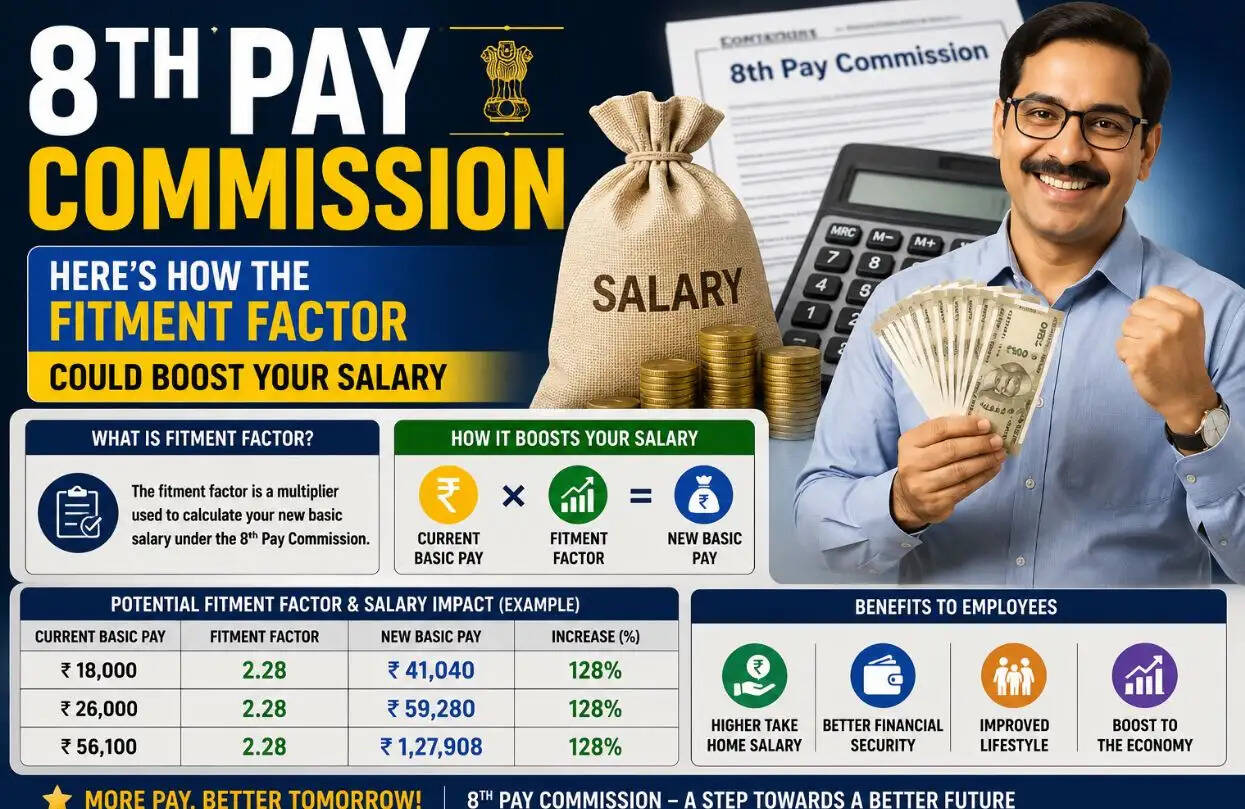
RJ Kesari News Desk: The fitment factor is the key element that determines the revised basic salary, and once the basic pay increases, other allowances such as House Rent Allowance (HRA) and several retirement benefits also rise automatically.
Let's understand how this formula works and how much your salary could increase under different fitment factor scenarios.
What Is the Fitment Factor?
The fitment factor is a multiplier used by every Pay Commission to revise the existing basic salary of government employees.
Instead of increasing salaries by a fixed amount, the government multiplies the current basic pay by the approved fitment factor to calculate the revised salary.
In simple terms:
New Basic Pay = Existing Basic Pay × Fitment Factor
A higher fitment factor directly results in a higher basic salary, which also increases allowances and retirement benefits linked to basic pay.
Why Is the Fitment Factor So Important?
Employee unions have reportedly demanded a fitment factor ranging between 2 and 5, while the government is carefully evaluating its financial impact before taking a final decision.
Since the fitment factor determines the revised salary structure, even a small increase in this multiplier can substantially improve an employee's monthly income.
Salary Calculation: How Much Could Your Basic Pay Increase?
To understand the impact, consider a Pay Level 4 employee whose current basic salary is ₹25,500.
If different fitment factors are applied, the revised basic pay would look like this:
| Fitment Factor | Current Basic Pay | Revised Basic Pay |
|---|---|---|
| 2.0x | ₹25,500 | ₹51,000 |
| 2.5x | ₹25,500 | ₹63,750 |
| 3.0x | ₹25,500 | ₹76,500 |
These figures are only illustrative. The actual salary revision will depend on the recommendations of the 8th Pay Commission and final approval by the Central Government.
Higher Basic Pay Means Higher HRA
One of the biggest advantages of an increased basic salary is the automatic rise in House Rent Allowance (HRA).
Since HRA is calculated as a percentage of the basic pay, employees receive higher allowances whenever their basic salary is revised.
Under the current pay structure, HRA depends on the category of the city where an employee is posted.
How HRA Is Calculated
If the existing HRA rates continue under the new pay structure:
- 30% for X-category cities
- 20% for Y-category cities
- 10% for Z-category cities
Assuming the revised basic pay becomes ₹51,000 under a 2x fitment factor, the monthly HRA would be:
| City Category | HRA Rate | Monthly HRA |
| X Category | 30% | ₹15,300 |
| Y Category | 20% | ₹10,200 |
| Z Category | 10% | ₹5,100 |
This demonstrates how a higher basic salary significantly increases monthly allowances.
More Than Just Salary: Other Benefits Will Also Increase
The impact of the fitment factor is not limited to monthly salary alone.
As the basic pay rises, several other financial benefits linked to it are also expected to increase, including:
- House Rent Allowance (HRA)
- Dearness-related benefits (if applicable)
- Retirement and pension calculations
- Leave encashment
- Gratuity and other service-related benefits
This is why the fitment factor is considered the most important component of every Pay Commission.
What Experts Say
Financial experts believe that even a modest increase in the fitment factor can make a significant difference to employees' overall earnings.
Since multiple salary components are calculated as a percentage of the basic pay, every upward revision creates a cascading effect on total monthly income and long-term retirement benefits.