
ITR Filing 2026: Last Date, Penalty Rules, and Key Mistakes to Avoid While Filing Your Income Tax Return
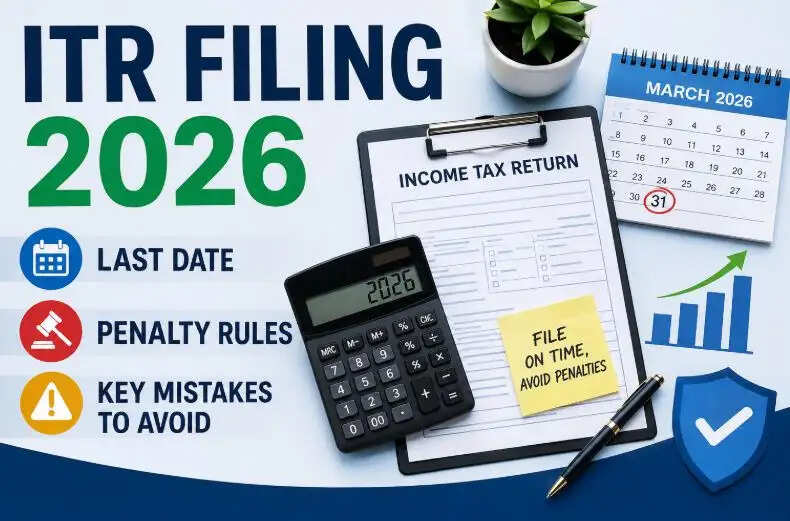
The Income Tax Return (ITR) Filing 2026 season has officially begun, and taxpayers across India are preparing to submit their returns for the Financial Year 2025-26 (Assessment Year 2026-27). Whether you are a salaried employee, freelancer, business owner, or self-employed professional, filing your tax return before the due date is essential to avoid penalties and ensure smooth processing of refunds.
Missing the prescribed deadline can lead to a penalty of up to ₹5,000, interest on unpaid taxes, and other complications. Understanding the latest filing deadlines and compliance requirements can help taxpayers avoid unnecessary trouble.
ITR Filing 2026 Last Date: Important Deadlines for Different Taxpayers
The Income Tax Department has prescribed separate deadlines based on the category of taxpayers.
For most salaried individuals and Hindu Undivided Families (HUFs) filing ITR-1 or ITR-2, the last date to file returns is July 31, 2026.
A significant relief has been provided to non-audit business taxpayers this year. Individuals and professionals filing ITR-3 or ITR-4 without audit requirements can now submit their returns until August 31, 2026.
Businesses and entities requiring tax audits have a filing deadline of October 31, 2026, while taxpayers covered under transfer pricing regulations can file returns until November 30, 2026.
Those who miss the original due date can still file a Belated ITR until December 31, 2026. In case of any mistakes or omissions, taxpayers can submit a revised return up to March 31, 2027.
What Happens If You Miss the ITR Filing Deadline?
Many taxpayers assume they can file returns later without consequences, but missing the deadline can result in direct financial losses.
Under Section 234F of the Income Tax Act, taxpayers with annual income above ₹5 lakh may be required to pay a penalty of up to ₹5,000 for late filing. Individuals earning up to ₹5 lakh may face a reduced penalty of up to ₹1,000.
Apart from the penalty, taxpayers may also be required to pay interest on any outstanding tax liability. Delayed filing can further affect the ability to carry forward business losses or capital losses to future financial years.
Tax refunds may also take significantly longer to process when returns are filed after the due date.
Benefits of Filing Your Income Tax Return on Time
Timely ITR Filing offers several advantages beyond legal compliance.
One of the biggest benefits is faster processing of tax refunds. Taxpayers who have excess tax deducted at source (TDS) can receive their refunds much sooner when returns are filed within the prescribed timeline.
A properly filed income tax return also strengthens an individual's financial profile. Banks and financial institutions frequently request ITR documents while evaluating applications for home loans, personal loans, business loans, and credit facilities.
Additionally, ITR documents are often required during international visa applications, making them an important financial record.
Filing on time also minimizes the risk of receiving notices from the Income Tax Department due to delayed compliance.
Common ITR Filing Mistakes That Can Trigger Tax Notices
Tax experts advise taxpayers to review their returns carefully before final submission. Even minor errors can lead to unnecessary scrutiny or notices.
The first step is selecting the correct ITR Form according to your income sources. Using the wrong form can lead to return rejection or compliance issues.
Taxpayers should also verify all income details with Form 26AS, the Annual Information Statement (AIS), and the information pre-filled on the Income Tax portal. Any mismatch should be corrected before submission.
Income from salary, interest, rent, capital gains, freelancing, or business activities should be accurately reported. Tax deductions and exemptions should only be claimed if valid supporting documents are available.
Before clicking the final submit button, carefully review every section of the return. Most importantly, taxpayers must complete the e-verification process after filing. Without e-verification, the Income Tax Department does not consider the return valid.
Final Words
As the ITR Filing 2026 season progresses, taxpayers should avoid waiting until the last moment. Filing returns before the deadline not only helps avoid penalties but also ensures faster refunds, stronger financial credibility, and hassle-free compliance.
With a maximum late fee of ₹5,000, potential interest charges, and the risk of losing important tax benefits, timely filing remains the smartest approach for every taxpayer.