
ITR Filing 2026: Avoid These Common Mistakes While Filing Your Income Tax Return
The Income Tax Return (ITR) filing season for the Financial Year 2025-26 (Assessment Year 2026-27) is officially underway. While filing your return may seem straightforward, even a minor error can lead to Income Tax notices, delayed refunds, additional tax liabilities, or penalties.
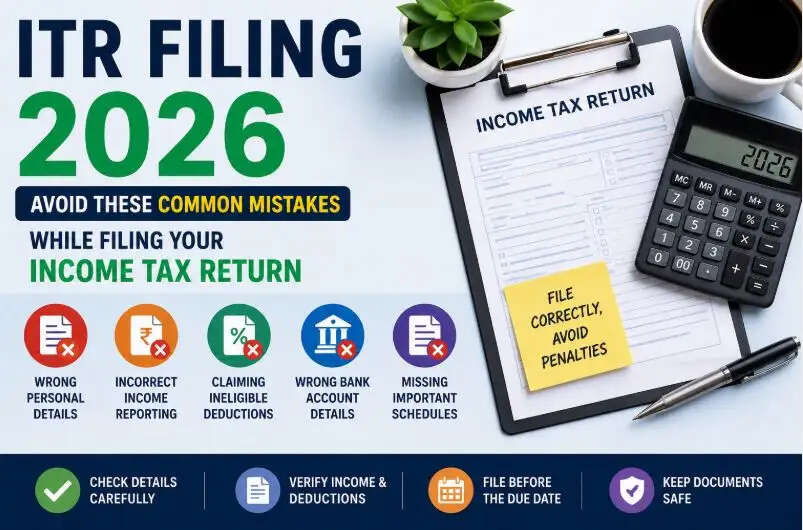
Tax experts advise taxpayers to carefully review every detail before submitting their returns. Whether you're a salaried employee, freelancer, business owner, or investor, avoiding common filing mistakes can save you from unnecessary complications later.
Know the Important ITR Filing Deadlines
Before filing your return, make sure you are aware of the applicable deadlines:
- ITR-1 and ITR-2 taxpayers: July 31, 2026
- ITR-3 and ITR-4 taxpayers: August 31, 2026
Filing your return before the due date not only helps avoid penalties but also ensures faster processing and refund issuance.
Choosing the Wrong ITR Form Can Create Problems
One of the most common mistakes taxpayers make is selecting the incorrect ITR form.
Different forms are designed for different categories of taxpayers:
- ITR-1 is generally meant for salaried individuals with simple income sources.
- ITR-2 applies to individuals with capital gains and multiple income sources.
- ITR-3 is for taxpayers earning income from business or professional activities.
- ITR-4 is used under the presumptive taxation scheme.
Selecting the wrong form can result in the Income Tax Department declaring your return defective, which may require refiling and could trigger additional scrutiny.
Don't Confuse Financial Year and Assessment Year
Another frequent error occurs when taxpayers mistakenly select the wrong Assessment Year (AY).
For income earned during Financial Year 2025-26, the correct assessment year is AY 2026-27.
Choosing the wrong assessment year can lead to processing delays, mismatches in tax records, and possible notices from the department. Always verify the year carefully before proceeding with submission.
Double-Check Personal Information
Incorrect personal details can create unnecessary hurdles during return processing.
Before filing, ensure the following details match your PAN records:
- Full name
- Date of birth
- PAN number
- Mobile number
- Email address
- Residential address
Any mismatch between your ITR and PAN database information may delay processing or require additional verification.
Verify Bank Account Details Carefully
Taxpayers expecting an Income Tax Refund should pay special attention to banking information.
Incorrect details such as:
- Bank account number
- IFSC code
- Account type
can result in refund delays or failed refund credits.
Always cross-check your banking information before submitting the return.
Declare All Sources of Income
One of the biggest reasons taxpayers receive notices is the failure to disclose complete income details.
Many individuals report only their salary income while forgetting to include:
- Savings account interest
- Fixed Deposit (FD) interest
- Rental income
- Capital gains from shares
- Mutual fund profits
- Dividend income
- Freelance or side income
The Income Tax Department now has access to extensive financial data through AIS (Annual Information Statement) and Form 26AS. Any mismatch between reported income and departmental records can trigger scrutiny.
Match Your Return with AIS and Form 26AS
Before filing your return, compare your income details with:
- Annual Information Statement (AIS)
- Form 26AS
- Salary Form 16
- Bank statements
This step helps identify discrepancies and ensures that all reported income and taxes paid are accurately reflected in your return.
Follow the Correct Data Entry Format
Even simple formatting mistakes can lead to filing errors.
While filling out the return:
- Enter dates in the correct format (DD/MM/YYYY)
- Verify income figures carefully
- Check PAN and Aadhaar details
- Review account numbers and IFSC codes
Incorrect formatting can result in validation errors or delays in processing.
Review Everything Before Clicking Submit
Many taxpayers rush through the final stage of filing. However, taking a few extra minutes to review your return can prevent costly mistakes.
Before submission:
✔ Verify all income details
✔ Check deductions and exemptions claimed
✔ Confirm tax calculations
✔ Review personal and banking information
✔ Match data with AIS and Form 26AS
Don't Forget to E-Verify Your Return
Filing the return is only half the process. After submission, taxpayers must complete ITR e-verification.
Without e-verification, the Income Tax Department treats the return as incomplete and invalid.
You can e-verify using:
- Aadhaar OTP
- Net Banking
- Bank Account Validation
- Demat Account Verification
Final Thoughts
Filing your Income Tax Return 2026 accurately is essential for avoiding notices, penalties, and refund delays. Most tax-related issues arise not because of tax evasion but due to simple filing errors such as selecting the wrong form, omitting income sources, or entering incorrect details.
By carefully reviewing your return, matching information with official records, and completing e-verification, you can ensure a smooth and hassle-free ITR filing process.