
India Rejects America’s 12.5% Tariff Proposal, Warns Against Unilateral Trade Decisions
India US Trade Dispute 2026: Tensions between New Delhi and Washington have escalated after India strongly objected to an additional 12.5% tariff proposed by the United States.
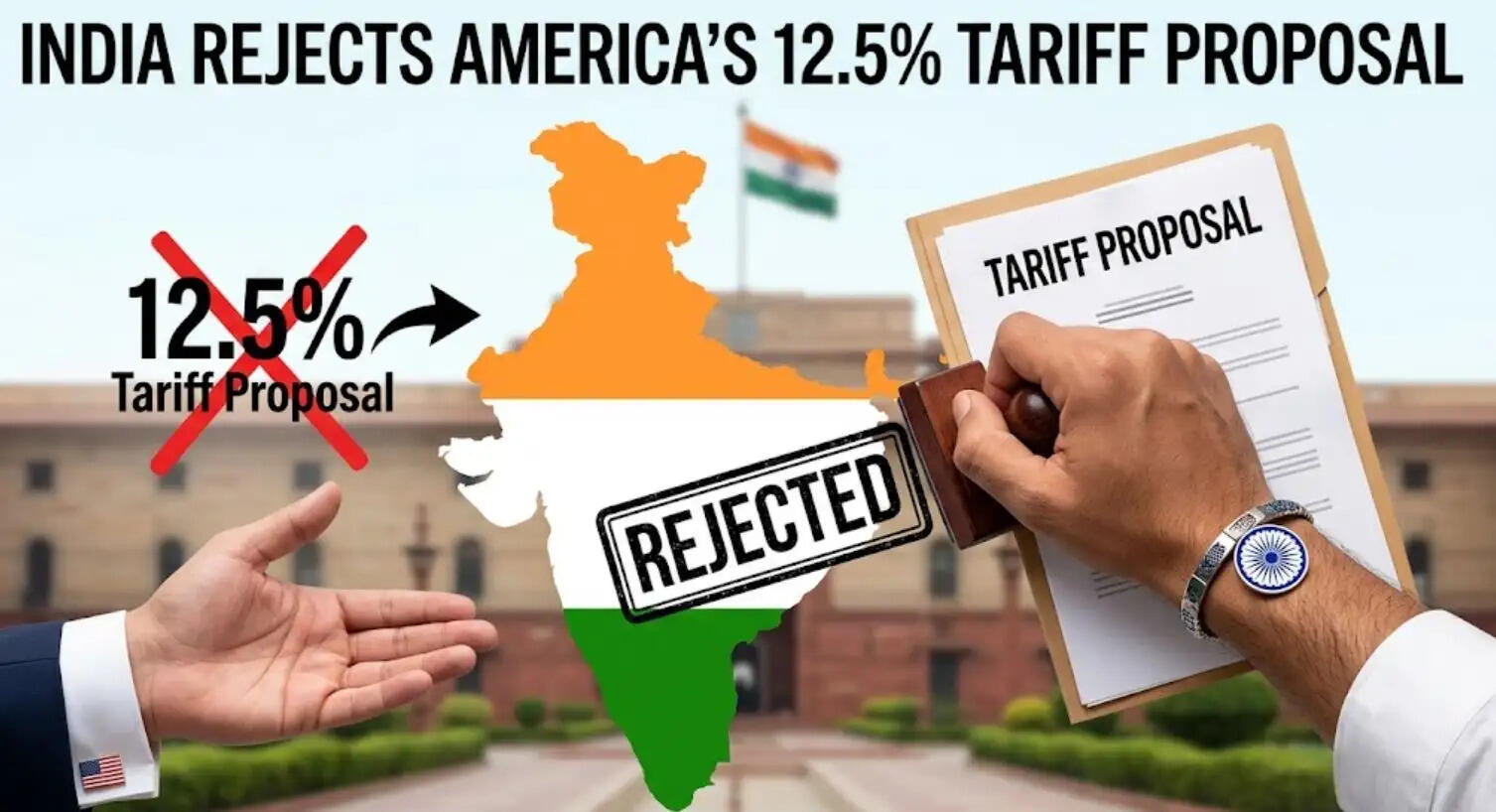
RJ Kesari News Desk: Indian trade officials have firmly communicated that international trade disputes must be resolved through bilateral trade negotiations US India frameworks and mutual consent, rather than unilateral trade penalties.
In response to the friction, India has formally appealed to the Office of the United States Trade Representative (USTR) to completely freeze and reconsider the punitive economic measures.
India Flaws the Logic of the USTR Section 301 Investigation
The proposed tariffs stem from the Section 301 investigation tariff framework, a legal tool Washington uses to penalize nations it accuses of trading in goods manufactured via forced or bonded labor.
However, India has directly challenged the structural validity of the American inquiry, stating that the USTR report suffers from critical factual inaccuracies and legal flaws. New Delhi maintains that the USTR reached sweeping conclusions without producing verifiable, industry-wide data.
Official Stance: India’s Defense at the Public Hearing
Representing the nation at a high-level public hearing held on July 8, Brij Mohan Mishra, Joint Secretary in the Department of Commerce, presented a rigorous defense of India's labor laws and industrial supply chains.
               [USTR Section 301 Report]
                           │
         ┌─────────────────┴─────────────────┐
         ▼                                   ▼
[Legal & Factual Flaws]            [Sweeping Categorization]
 ├── Lacks credible evidence        ├── Grouped 46 distinct nations
 ├── Isolated sample cases          └── Ignores local economic realities
 └── General business trends only
Mishra emphasized that eliminating bonded labor is a non-negotiable constitutional mandate for India, as well as a strict obligation under international humanitarian law. He argued that levying broad, heavy tariffs requires concrete, credible evidence—a standard that the current USTR report fails to meet.
The Flawed Grouping of 46 Distinct Nations
A primary point of contention raised by the Department of Commerce India public hearing delegation was the unfair categorization used by American trade researchers:
-
Sloppy Generalization: The USTR report lumped 46 entirely different developing nations into a single risk category, completely ignoring the unique socio-economic realities, regulatory frameworks, and enforcement mechanisms of individual countries.
-
Lack of Direct Evidence: Instead of identifying specific non-compliant factories or industry clusters, the American investigation relied on a handful of isolated, selective cases and general business trends to justify a country-wide penalty.
-
No Economic Justification: India pointed out that the report fails to provide any economic or legal justification as to why a blanket 12.5% tariff increase is necessary for an entire nation's export market.
Strategic Outlook: As one of America's key strategic trading partners in Asia, India's sharp pushback signals that it will not quietly absorb protectionist policies. If Washington pushes ahead with the unilateral 12.5% hike, it could trigger global trade retaliation, with New Delhi potentially mapping out reciprocal tariffs on high-value American imports to protect its domestic economic interests.