
Why Leaving Excess Money Sitting in Your Bank Account Could Actually Make You Poorer
Savings Account Hidden Traps: For generations, keeping hard-earned cash safely tucked away in a traditional bank account has been viewed as the ultimate risk-free financial strategy. After receiving their monthly salaries, many individuals comfortably let accumulated sums of ₹10 lakh, ₹22 lakh, or even more sit idle for years.
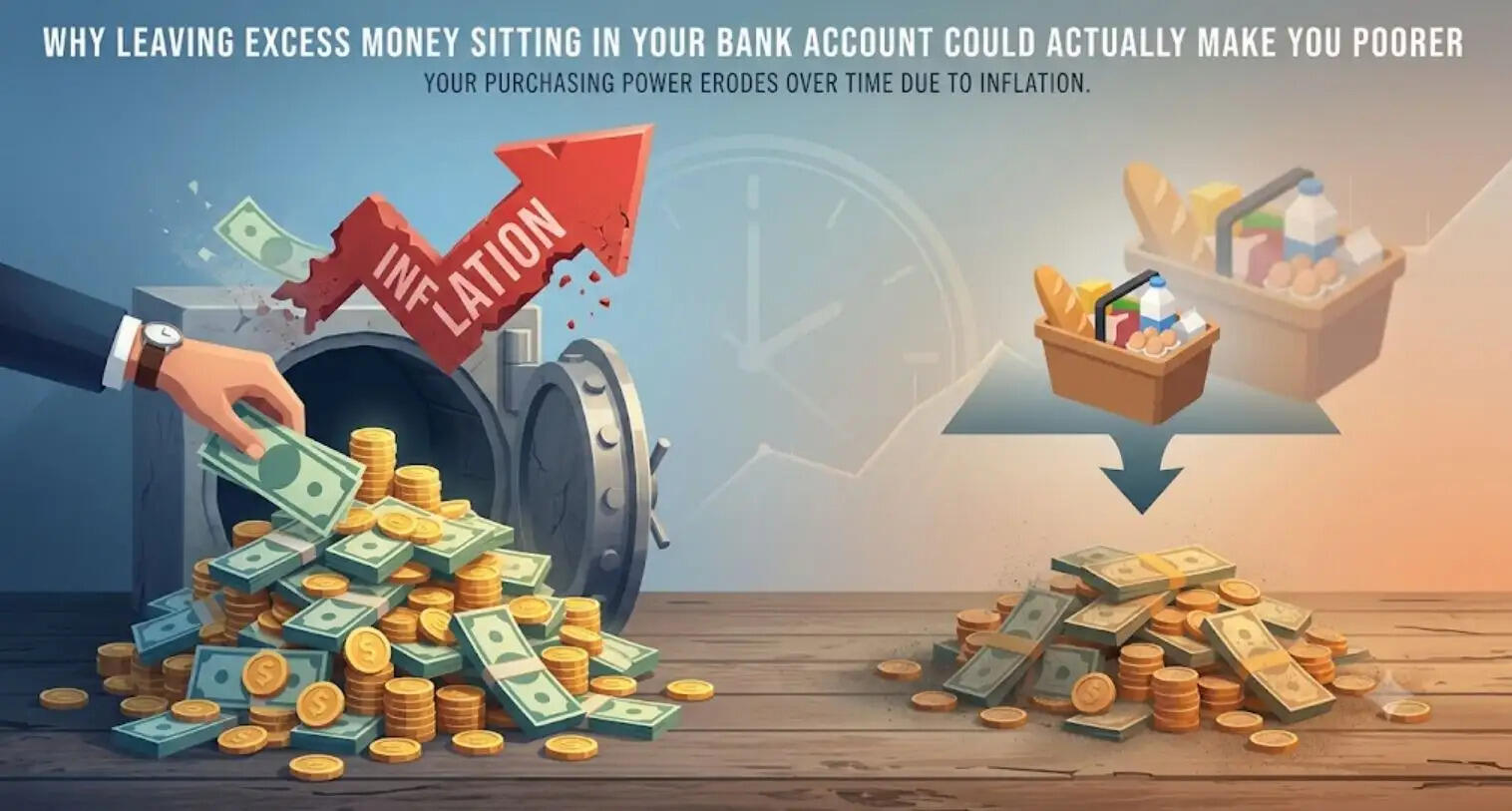
RJ Kesari News Desk: While your principal amount remains structurally secure from bank robberies, financial experts warn that leaving large capital blocks inactive inside a basic savings account is guaranteed to trigger a silent, long-term financial loss.
The Invisible Erosion: How Inflation Destroys Purchasing Power
The ultimate trap of a standard banking account is the massive divergence between retail banking returns and macroeconomic reality. Today, the vast majority of commercial banks provide a modest low interest rate risk profile, yielding just 2.5% to 3% in annual interest. On the flip side, the average long-term consumer inflation rate hovers stubbornly between 5% and 6%.
This economic gap causes purchasing power depreciation. Even though your digital bank balance technically crawls upward every quarter, the actual market value of that money is steadily decaying. In simple terms, the exact same stack of cash will buy far fewer goods, services, and assets a decade down the line than it can cover today.
The ₹10 Lakh Math: A Real-World Financial Reality Check
To understand the severe impact of inflation on savings, consider a practical simulation over a ten-year horizon:
-
The Bank Growth: Suppose you leave a lump sum of ₹10,00,000 in a savings account accumulating a fixed 2.5% annual interest rate. After exactly 10 years, your ledger balance will expand to approximately ₹12.8 lakh.
-
The Inflation Reality: If localized inflation remains pegged at a baseline of 6% annually over that same decade, a basket of lifestyle goods worth ₹10 lakh today will cost an estimated ₹17.9 lakh to purchase in the future.
-
The Deficit: Despite gaining interest, your real wealth has effectively shrunk, leaving you facing a massive ₹5 lakh shortfall in actual purchasing capability.
Setting Up a Strategic Emergency Fund Allocation Strategy
Does this mean you should completely empty out your bank accounts? Absolutely not. According to wealth management professionals, a savings account should function strictly as a temporary holding zone for instant liquidity, not a multi-year wealth generator.
A smart emergency fund allocation strategy requires maintaining a cash cushion equivalent to 6 to 12 months of your essential household expenses. This baseline reserve ensures you can navigate sudden job transitions or medical emergencies without being forced to break long-term investments prematurely.
Alternative Channels: Smarter Investment Paths for Excess Capital
Any financial surplus that stretches past your standard emergency safety net should be immediately repositioned into higher-yielding assets to outpace retail inflation.
Depending on your individual risk tolerance and timeline, consider deploying idle funds across these primary avenues:
                  [Idle Surplus Capital]
                            │
         ┌──────────────────┴──────────────────┐
         ▼                                     ▼
[Short-Term / Low-Risk]              [Long-Term / Growth]
 ├── Fixed Deposits (FDs)             ├── Equity Mutual Funds
 ├── Liquid Mutual Funds              └── Direct Stock Portfolios
 └── Ultra-Short Debt Funds
-
Fixed Deposits & Liquid Funds: Excellent for near-term milestones (1 to 3 years), offering significantly higher interest brackets than savings accounts with immediate or fast liquidity.
-
Debt Funds & Diversified Equities: Ideal for long-term targets stretching past 5 years, providing compounding returns that historically beat the baseline rate of inflation, thereby safely preserving your generational wealth.