
Marriage Registration Benefits: Why Not Registering Your Marriage Can Create Legal and Financial Problems
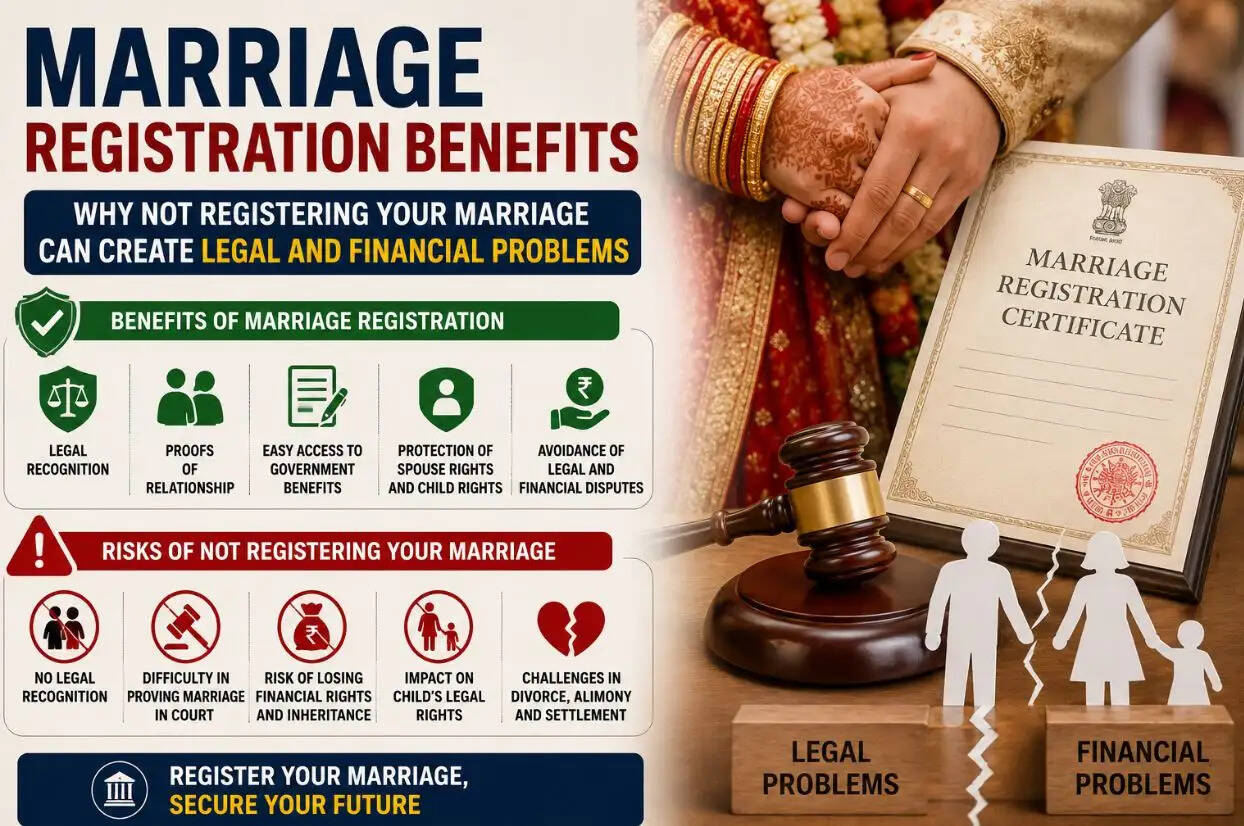
RJ Kesari News Desk: In India, marriage is celebrated with traditions, rituals, and family gatherings. However, many couples overlook one crucial step after the wedding—marriage registration.
While religious ceremonies establish a social bond, a marriage certificate serves as the official legal proof of marriage. Without it, couples may face unnecessary hurdles while applying for passports, visas, bank loans, insurance claims, inheritance, and several government benefits.
Here's why registering your marriage is more important than ever.
Marriage Registration Is More Than Just a Formality
Many people believe that completing traditional wedding rituals is enough. However, in today's legal and administrative system, a registered marriage provides official recognition of the marital relationship.
In the landmark Seema vs. Ashwani Kumar (2006) case, the Supreme Court directed all states to make marriage registration mandatory to protect the legal rights of spouses.
Although an unregistered marriage may still be legally valid if performed according to applicable laws, registration makes it significantly easier to prove the marriage whenever required.
No Marriage Certificate? Passport and Visa Applications May Become Difficult
A marriage certificate is often an essential document when:
- Applying for a spouse's passport
- Changing your surname after marriage
- Applying for a dependent or spouse visa
- Seeking permanent residency abroad
- Sponsoring your partner for international travel
Many countries require an officially registered marriage certificate before issuing family or dependent visas. Without it, applicants may face additional verification, delays, or document requests.
Joint Bank Accounts and Financial Services Can Become Complicated
After marriage, couples often open joint bank accounts or nominate each other for various financial products.
Without a marriage certificate, banks may ask for additional proof of relationship while:
- Opening a joint savings account
- Updating nominee details
- Investing in fixed deposits
- Purchasing mutual funds or other financial products
This can make routine financial transactions more time-consuming.
Getting a Joint Home Loan May Take Longer
Many married couples apply jointly for:
- Home loans
- Business loans
- Personal loans
- Vehicle loans
Financial institutions frequently request a marriage certificate as proof of the marital relationship.
If the marriage isn't registered, additional documentation may be required, which could delay the loan approval process.
Insurance Claims Can Become More Complicated
Whether it's life insurance, health insurance, or accidental insurance, policyholders usually nominate their spouse as the beneficiary.
In the absence of a registered marriage, insurers may ask for extra legal documents before processing claims.
This additional verification can delay claim settlements at a time when families need financial support the most.
Property and Inheritance Disputes Become Harder to Resolve
A marriage certificate plays a crucial role in:
- Property ownership disputes
- Legal inheritance claims
- Succession matters
- Transfer of assets after a spouse's death
Without official proof of marriage, surviving spouses may need to produce additional evidence or obtain a succession certificate, making the legal process longer and more expensive.
Government Benefits May Not Be Easily Available
Several government schemes and employee welfare benefits require proof of marriage.
A marriage certificate may be needed to claim:
- Family pension
- Medical benefits
- Employee-dependent benefits
- Government welfare schemes
- Family identity-related services
Without registration, accessing these benefits may involve additional paperwork and verification.
Major Disadvantages of Not Registering Your Marriage
If your marriage is not officially registered, you may face:
- Difficulty obtaining passports and spouse visas
- Delays in opening joint bank accounts
- Challenges in adding your spouse as a nominee
- Additional documentation for joint loans
- Complications during insurance claim settlements
- Legal hurdles in property and inheritance disputes
- Delays in government schemes and family benefits
- Lengthy legal procedures to establish marital status
How to Register Your Marriage in India
Marriage registration in India is generally carried out under the applicable personal marriage laws or the Special Marriage Act, 1954.
In most states, couples typically need:
- Identity proof
- Address proof
- Wedding photographs
- Marriage invitation (if applicable)
- Witnesses
- Passport-size photographs
Once verified, the concerned authority issues an official Marriage Certificate, which serves as permanent legal proof of marriage.