
India's Longest Bullet Train Planned! 1,705 KM High-Speed Rail Corridor to Connect Delhi and Siliguri
High-Speed Rail Network: India is preparing for a major transformation in railway infrastructure with plans to expand its high-speed rail network. After the Mumbai-Ahmedabad Bullet Train project, the government is now moving forward with the proposed Delhi–Varanasi–Siliguri Bullet Train Corridor, which is expected to become the longest high-speed rail route in the country.
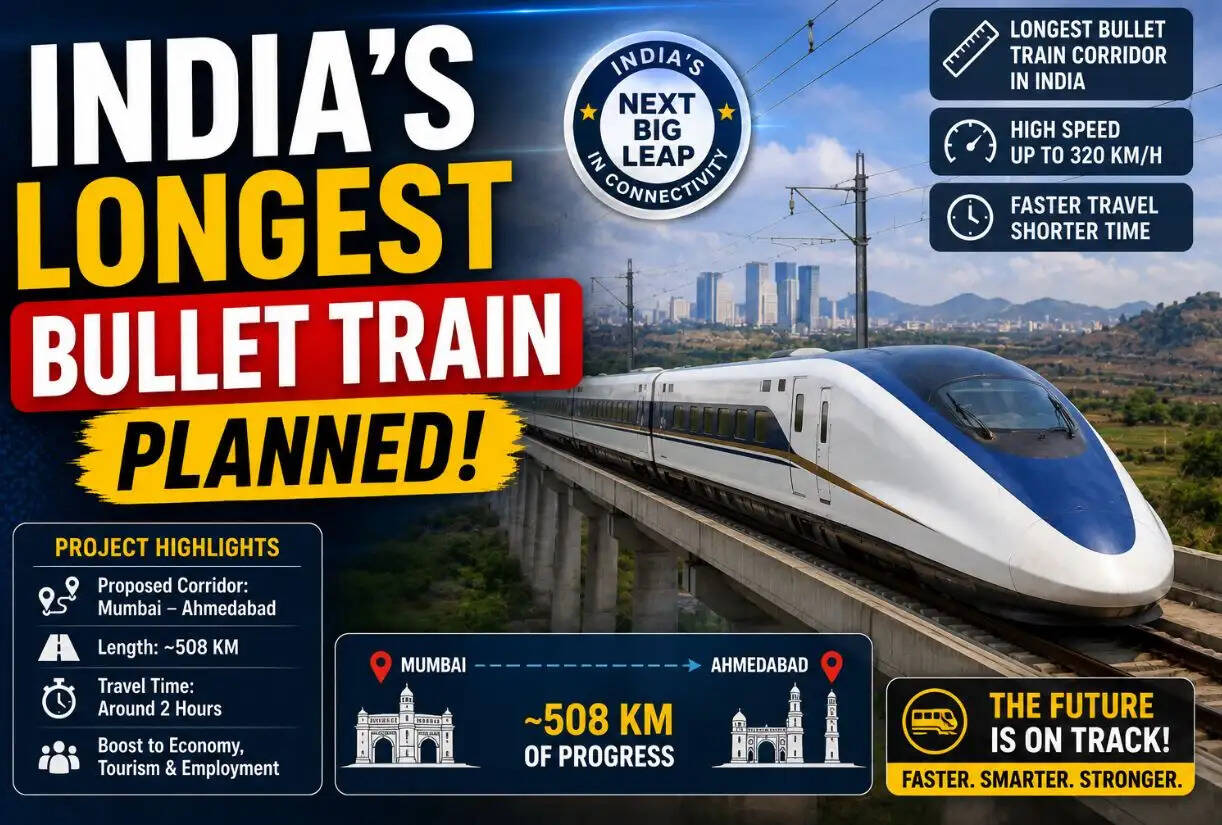
RJ Kesari News Desk: Once completed, the corridor will significantly improve connectivity between Delhi, Uttar Pradesh, Bihar, and West Bengal, reducing travel time while boosting economic development and regional connectivity.
Delhi to Become India's Largest High-Speed Rail Hub
The National High Speed Rail Corporation Limited (NHSRCL), along with the Ministry of Railways, is working on an ambitious plan to transform Delhi into the country's largest high-speed rail hub.
The proposed bullet train corridors include:
- Delhi–Varanasi (with Ayodhya Link)
- Delhi–Varanasi–Siliguri
- Delhi–Ahmedabad
- Delhi–Amritsar–Jammu
The government aims to construct nearly 250 kilometres of high-speed railway track every year as part of its long-term infrastructure expansion strategy.
Delhi–Varanasi Bullet Train Corridor: Key Highlights
The proposed Delhi–Varanasi High-Speed Rail Corridor will span approximately 865 kilometres with an estimated investment of around ₹1.21 lakh crore.
The route is expected to pass through:
- Delhi
- Noida
- Jewar International Airport
- Mathura
- Agra
- Firozabad
- Etawah
- Kannauj
- Lucknow
- Rae Bareli
- Prayagraj
- New Bhadohi
- Varanasi
The project also includes a 9.4-kilometre tunnel near Jewar International Airport along with an underground station. In addition, a 135-kilometre link corridor connecting Lucknow and Ayodhya has also been proposed.
Delhi–Siliguri to Become India's Longest Bullet Train Route
The proposed Delhi–Siliguri High-Speed Rail Corridor will stretch approximately 1,705 kilometres, making it India's longest bullet train project.
The planned route will connect several major cities, including:
- Delhi
- Noida
- Mathura
- Agra
- Etawah
- Lucknow
- Varanasi
- Patna
- Siliguri
Officials have also indicated that the corridor could be extended to Guwahati in the future, further strengthening connectivity across eastern and northeastern India.
Travel Time Will Be Reduced Dramatically
The new high-speed rail network is expected to cut travel time between major cities significantly.
Estimated journey times:
- Delhi to Lucknow – Around 2 hours 10 minutes
- Noida International Airport to Lucknow – Around 1 hour 40 minutes
- Delhi to Varanasi – Around 3 hours 50 minutes
- Delhi to Siliguri – Around 6 hours
Currently, travelling from Delhi to Varanasi by train takes nearly 11–12 hours, while Delhi to Siliguri usually requires around 20 hours.
India's First Indigenous Bullet Train Under Development
India is also developing its first indigenous high-speed train, known as B35, which is being manufactured by BEML.
Some of its key features include:
- Designed speed of 350 km/h
- Operational speed of 320 km/h
- Expected trial on the Mumbai–Ahmedabad High-Speed Rail Corridor
- Equipped with advanced safety and modern passenger comfort features
The train is being developed using globally proven high-speed rail technology while incorporating indigenous engineering capabilities.
Bullet Trains Could Compete with Air Travel
Experts believe that bullet trains can become a strong alternative to domestic flights on several routes.
Some of the major advantages include:
- City-centre stations
- Faster boarding process
- Minimal check-in formalities
- Reduced total travel time
- Improved passenger convenience
For medium-distance journeys, high-speed rail could provide a faster and more seamless travel experience than air transport.